What Did the Early Church Believe About the Cross? The Atonement Before Penal Substitution
The early church view of the atonement was bigger than guilt and legal payment. The first Christians proclaimed rescue, not a courtroom.
What Did the Early Church Believe About the Cross? The Atonement Before Penal Substitution
If you grew up in a Western Christian church, you probably learned one version of the gospel: you sinned, God is just, and Jesus took the punishment you deserved. That framework, called penal substitutionary atonement, has dominated Protestant theology for centuries. But for the first thousand years of Christianity, it wasn’t the primary way the church talked about what the cross accomplished. The earliest Christians described something bigger, and it answers questions that the guilt-and-payment model struggles with.
This matters because the hardest skeptical critiques of Christianity tend to target the narrow version. “He was only dead for a day and a half.” “Anyone would take that deal.” “The system runs on guilt.” Those objections land when the cross is framed as a transaction measured by suffering. But the early church fathers weren’t measuring suffering. They were describing a rescue.
Irenaeus and the whole life of Christ
Irenaeus, born around 130 AD and a student of Polycarp (who personally knew the apostles), laid out a vision of redemption he called recapitulation. The idea is that Christ relived the human story and got right what Adam got wrong. Adam was created to grow into the image of God but grabbed at it too soon. Christ walked the path patiently, through every stage of human life.
What makes Irenaeus striking is that he didn’t think the death alone was the saving act. The entire life of Christ, from birth to grief to weariness to death, was God entering into every dimension of human experience to heal it from within. As Nate puts it in the episode:
“The problem isn’t ‘you did bad things and you need to feel guilty.’ The problem is that humanity is stuck in a condition of death, and a good person dies just as surely as a bad one. The solution isn’t legal payment. It’s a rescue.”
- Nate Hanson
That reframing changes everything about how the hardest questions land. If the human problem is death and alienation from God rather than a courtroom debt, then the cross isn’t sized by the amount of pain involved. It’s sized by who walked into it.
Athanasius and the scandal of a deathless God dying
About 150 years after Irenaeus, Athanasius of Alexandria wrote On the Incarnation, one of the most important works in Christian history. His most famous line captures the early church vision: “He was made man that we might be made God.” Not that humans become separate gods, but that humanity is brought back into communion with divine life, pulled out of death and into something it was always meant for.
Athanasius also provides one of the strongest answers to the “he was only dead for a day and a half” critique. The scandal of the cross, in his framework, isn’t the duration or intensity of the suffering. It’s that the one who is life experienced death at all. The episode uses a vivid analogy:
“If someone told you a fire was burning underwater, the first thing you would ask probably isn’t ‘how long has it been burning?’ The first thing you’d ask is ‘how is that even possible?’ That’s how Athanasius sees the cross.”
- Nate Hanson
The deathless God tasting death is the event that shouldn’t be possible. Duration is beside the point.
Gregory of Nazianzus and the healing principle
Gregory of Nazianzus, Archbishop of Constantinople in the fourth century, gave the early church one of its most enduring theological principles: “What has not been assumed has not been healed.” If human minds are fallen, Christ needs a human mind to heal them. If human emotions are broken, Christ needs human emotions. If death is the problem, Christ has to die.
This principle means the incarnation itself, from birth to crucifixion, is where the saving happens. The cross is the climax, but the whole life matters. Every part of Christ’s human experience is God reaching into a broken place and remaking it.
Christus Victor: the dominant framework for a thousand years
Scholars call this broader vision Christus Victor, “Christ the victor.” The term comes from Gustaf Aulén’s landmark 1931 study Christus Victor, which traced how Christians have understood the cross across history. Aulén argued, and many scholars since have agreed, that the victory framework was the most consistent way the early church described what Christ accomplished, in both the Greek-speaking East and the Latin-speaking West.
In this framework, the cross isn’t a payment. It’s almost a . Christ entered the territory of death and defeated it from within. Gregory of Nyssa described it with an image that sounds wild but reveals how the early fathers thought: Christ’s humanity was like bait on a fish hook. Death swallowed a human being, as it swallows everyone, but hidden inside that humanity was divinity. Death choked on it and was destroyed from the inside.
The ancient Christian hymn still sung in Orthodox churches today captures it: “Christ is risen from the dead, trampling down death by death, and upon those in the tombs bestowing life.”
Why this reframe matters now
The critiques that feel devastating against a guilt-and-payment-only gospel lose their force when you step into the wider picture. “Anyone would take that deal” misses the point when the cross reveals divine character rather than creating a debt. “The model works best for the worst people” falls apart when the human problem isn’t personal guilt but a universal condition of death that claims good and bad people alike.
None of this means penal substitution is a lie. There is substitutionary language in the New Testament. Paul writes about it. But what most Western Christians were taught as the gospel, the one framework and the whole point, is actually a piece of a much larger picture, and a piece that didn’t become dominant until well over a thousand years after Jesus.
The earliest Christians held something richer. The gospel they proclaimed wasn’t “you’re terrible, now feel grateful.” It was “you’re dying, you’re trapped in a decaying world, and God has broken into the prison. You’re invited into a whole new kind of life.” The response to that isn’t guilt. It’s participation.
If you’ve carried honest questions about the cross that nobody around you could answer well, it might not be the faith that’s too weak. It might be that the framework you were given is too small. The earliest Christians had a much bigger one.
More Episodes

Are the Gospels Historically Reliable? What the Evidence Shows
Lydia McGrew on the evidence for Gospel reliability that most Christians have never been shown.
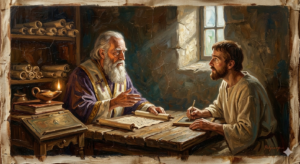
What Happened After the Apostles Died? How Polycarp Bridges the Gap
Polycarp bridges the gap between the apostles and the rest of church history. The chain is shorter than you think.

N.T. Wright: Do Christians Go to Heaven When They Die?
Do Christians go to heaven when they die? NT Wright says Christian hope is resurrection and new creation.
Premium Membership
Get the full, unedited version of every interview, plus video, and help Faith Lab reach more people who need it.
JOIN PREMIUM